

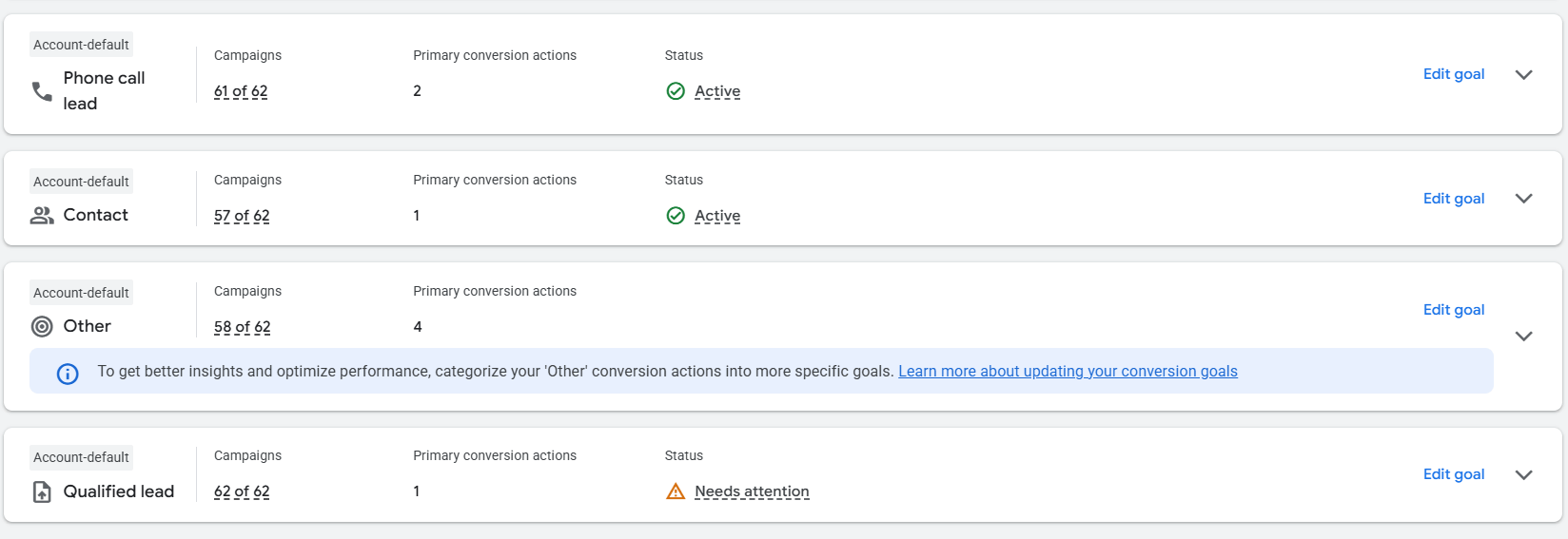
If you’re spending money on Google Ads in 2026 without rock-solid conversion tracking, you don’t have a Google Ads strategy. You are essentially playing blackjack blindfolded.
We say that as an agency that has spent the last several years auditing accounts across dental, psychiatry, e-commerce, legal, luxury, and home-services niches. The single consistent variable we see that separates the accounts that consistently compound into long-term wins from the accounts that flame out within two budget cycles is, almost without exception, the quality of their conversion tracking. Not bidding strategy. Not creative. Not even keywords. Tracking.
This isn’t a “best-practices, you should do it” post. We’re going to walk through the four conversion-tracking patterns we see in client audits, including the worst-case pattern, where an account slowly dies because no one can tell whether it’s working. And we’ll show you how to identify which one your account is closest to.
The four conversion-tracking patterns we see in every audit
When YoYoFuMedia takes over an account or runs a paid audit, we start with:
- what’s being tracked
- where it’s being passed back to Google
- whether the tracking matches the actual business outcome the client cares about.
Almost every account we look at falls into one of four buckets below:
Pattern 1: Good tracking even makes up for sloppy campaign management
We took over an account a while back that had been running for more than five years on broad-match keywords with very little oversight and an empty change history. By every standard we apply in our audits, the structure was wrong. The match types were too loose, the search-term reports were full of garbage that should have been negatived months earlier, and the bidding hadn’t been touched in a year.
And yet the account was performing. Conversions were steady. Cost per lead was reasonable. The client was happy.
Why? Because from day one, this client had treated conversion tracking with religious seriousness. The full stack of tracking: phone-call tracking with dynamic numbers, web-form tracking, qualified-lead pass-back from their CRM, and revenue values per conversion type. When we dug in, we realized the search terms triggering the campaign weren’t even what the keyword targets implied… they were a completely different cluster of long-tail queries. But because the tracking was honest, Google’s bidding algorithm had learned to bid up the queries that were actually converting, regardless of how messy the keyword structure looked.
The lesson we take away from this kind of account: good conversion tracking can compensate for a surprising amount of bad management. It cannot fix bad targeting forever, but it buys you years of runway while you tighten everything else.
Pattern 2: No tracking, just campaign management
The opposite client is the one we wish didn’t exist. Every quarter, we audit a potential new client that ask the same question some version of: “Should we keep running Google Ads? It costs a lot of money. We’re not sure it’s working.”
When we look under their account’s hood, the campaign is fine. The traffic shape is fine. The CTR is fine. The CPCs are fine. But because there is no conversion tracking (calls, forms, qualified-lead feedback) there is also no way to answer the client’s question. They have no idea how many leads they’re getting, how many calls came from Google versus an Instagram post versus a referral, and what the actual cost-per-acquisition is.
So they make decisions from guesses. A quiet week = “the ads aren’t working” and the budget gets cut. A noisy month = “the ads are crushing it” and the budget gets doubled. Both moves are random because both moves are made without data.
We’ve watched accounts in this pattern bleed money for years. It’s not because Google Ads doesn’t work for them, but because nobody can prove that it does.
If you can’t tell us with a straight face what your cost per qualified lead is over the last 90 days, you are running this pattern. The fix is not “spend more” or “spend less.” The fix is to get tracking in place so you can even know if your ads are working or not.
Pattern 3: The “tracking is awkward” potential client (the worst-case story)
This is the pattern that costs the most. We’ve audited potential clients who, on day one, decline conversion tracking because of one of three reasons: they don’t want a tracking phone number on their website that’s different from their main line, their previous campaign manager doesn’t include call tracking in their services, or they think tracking is “for later, once we know it’s working.”
We push back. We always push back. But the client is the client, and especially if its a big corporate client, we often get the “we’ll get it approved by IT next quarter.”
It never gets approved and gets lost in the corporate busy work. The campaign runs for a year, two years, sometimes longer. And then, usually in a slow season, we get an email that reads almost identically every time: “Things are way down this month. Is the campaign broken, can you audit our account again to see if our ads are working?”
We can pull up their account account and tell them everything we can see: same impression share, same search terms, same CPCs, same CTR. Nothing has changed inside Google Ads. But we can’t tell them whether they’re actually getting fewer leads, because we never had a baseline of leads to begin with. Maybe their organic traffic dropped. Maybe their referral source dried up. Maybe the seasonal slump is real. Maybe their phone forwarder is broken and they’ve been missing calls for three weeks. We literally cannot tell because it’s physically impossible to. We don’t have the data.
This is the failure pattern that hurts to write about because it’s preventable on day one. We don’t accept new clients who refuse basic call tracking and offline conversion tracking for exactly this reason. If you aren’t tracking every step of the way, you are wasting everyone’s time.
Pattern 4: The client who tracks conversion value, not just count
This is the gold-standard pattern, and it’s rarer than it should be. Instead of tracking a binary “conversion happened / didn’t happen,” this client passes a dollar value back to Google for every lead, sale, or form-fill. And the values aren’t all equal. A consultation request is worth less than a booked appointment, which is worth less than a closed deal. They’ve integrated their CRM with Google Ads so that the conversion event reflecting downstream revenue updates the bid signal automatically. They give us access to their CRM. And most importantly, that revenue data is recording inside their CRM habitually.
What this unlocks is the ability to use Target ROAS or value-based bidding meaningfully. Google’s algorithm stops optimizing for “more leads” (which can quietly fill your inbox with junk inquiries) and starts optimizing for the kind of leads that actually become customers. We’ve documented exactly this dynamic in our e-commerce Google Ads case study where a client went from 0 to 3x ROAS, and the unlock there was almost entirely on the tracking side, not the campaign side.
The discipline that comes with this pattern is also notable: clients who track conversion value tend to refuse to scale spend until they hit a profitability threshold. They’re harder to convince to “just turn it up.” That, too, is a feature, not a bug.
What we’ve actually seen with our clients
To put numbers behind the four patterns above: when we onboard a Google Ads client and the first 15-30 days are spent tightening tracking instead of touching the campaigns, we typically see a 20–40% improvement in measured cost-per-acquisition with no change to ad spend. The improvement isn’t because the campaign got better. It’s because we can finally see what was always working and are able to turn off campaigns that wasn’t.
We’ve documented this exact dynamic in our dental implant case study with Sage, where we took the practice from 0 to 20–55 new patients per month, and the foundation of that result wasn’t a clever campaign restructure. It was offline conversion tracking that fed real booked appointments back into Google’s bidding algorithm so the platform could learn what an actual qualified lead looked like, not just what a random form-fill looked like.
Same story in our SF Bay dental clinic engagement that produced 20 leads in the first month -> the on-site tracking was set up first, then call tracking, then the campaign. Reverse the order and you get pattern 2 or pattern 3 every time.
If you’d like a second set of eyes on your conversion tracking before you scale spend, we run free audits for prospective Google Ads clients.
Why 2026 makes the tracking gap wider, not narrower
Since 2022 or so, Google Ads has become more AI-driven, and more reliant on signal quality than ever. Smart Bidding, Performance Max, and the new journey-aware bidding strategies all share one assumption: the conversion data flowing in is accurate, complete, and reflects real business value.
If your tracking is broken or shallow, the algorithm is still going to optimize. It’s going to optimize toward whatever signal you give it. Give it form-fills and it’ll find you the cheapest, spammiest, most irrelevant form-fills, which often means the worst form-fills. Give it qualified leads and it’ll find qualified leads. Give it revenue and it’ll find revenue.
The platform’s automation rewards good tracking exponentially in 2026. The same platform punishes thin tracking exponentially. The middle ground of “I have the basic conversion pixel, I’m fine” barely exists anymore. Either your tracking is feeding the algorithm a meaningful signal, or your campaign is being optimized toward noise.
This is also why we get nervous when clients wants to implement new automated bidding features without first auditing tracking. The honest version of our answer is in our take on Google Ads attribution models — the bidding strategy is downstream of the attribution model, which is downstream of the conversion definition, which is downstream of whether you’re tracking the right thing in the first place. Skip the upstream work and the downstream lever doesn’t pull anything.
The minimum tracking stack we set up for every Google Ads client
Without turning this into a tutorial, the floor we won’t go below for a lead-gen client looks like this: a real call-tracking provider with dynamic number insertion (we typically use CallTrackingMetrics, and we’ve documented our setup process for clients who want to see how it works under the hood), web-form tracking with form-name granularity so we can tell apart a “schedule a call” form from a “newsletter signup” form, offline conversion import from the client’s CRM so qualified-lead and closed-deal data flows back to Google within 14 days, and conversion-value mapping per conversion type so the bidder has a real number, not just a 1.
For dental and healthcare clients, we add a fifth layer: appointment-booking-system integration, because a “form fill” and a “booked appointment” are different signals, and we want Google bidding on the second one. We get into more of that nuance in our call tracking for dental offices deep-dive.
If your current tracking doesn’t include all of those, your account is operating below the floor we find acceptable. That doesn’t mean you’re failing, plenty of accounts run for years on basic tracking. It does mean that you’re leaving 40-70% of measurable performance on the table, and that you’re going to have a much harder time scaling spend without losing efficiency. With all our clients we implement full call, text, form, booking tracking as well as lead qualifying.
Setting up the full tracking stack across call tracking, CRM offline imports, and value mapping is what we do all day, every day for our clients.
Frequently asked questions
Do I really need offline conversion tracking, or is on-site tracking enough?
If your sales cycle is 0 days and the website conversion is the sale (most direct-to-consumer e-commerce), on-site tracking is enough. If there’s any human follow-up between the conversion and the revenue (sales call, quote, appointment, qualified-lead screening) you need offline conversion import. Otherwise Google is bidding on form-fills, not on revenue, and you’ll silently optimize toward the leads that are easiest to capture rather than the leads that are most valuable.
What’s the difference between conversion tracking and conversion-value tracking?
Conversion tracking tells Google “an event happened.” Conversion-value tracking tells Google “an event happened and it was worth $X.” The second one is what unlocks Target ROAS bidding, value-based Smart Bidding, and the kind of optimization where Google starts preferring high-value leads over high-volume leads. If your conversion types vary in dollar impact at all, and almost every business’s do, you want value tracking, not just count tracking.
How long before I see a difference after fixing tracking?
In our experience, the bidding algorithm needs roughly 14 days of clean data before it starts shifting noticeably. The first thing you usually notice is that cost per measured conversion improves, even though spend hasn’t changed. What you are see is the algorithm finding signal where it was previously optimizing on noise. Real cost-per-acquisition improvements show up around the 30-day mark, and the compounding benefits show up between months 2 and 4.
Will fixing tracking save a campaign that’s already struggling?
Sometimes, but not always. If the account’s underlying problems are bad targeting, terrible landing pages, or a broken offer, no amount of tracking improvement will save it. Tracking gives you the ability to see what’s happening; it doesn’t fix what’s happening. That said, in our audits, the fastest meaningful wins almost always come from tracking work, because tracking exposes the real problem within days. We’d rather diagnose with clean data than guess with dirty data.
Is conversion tracking enough by itself, or do I still need to optimize bidding, keywords, and creative?
You still need all of it. Tracking is the foundation that makes the rest of the work compoundable. Without tracking, every keyword and creative test is a coin flip. With tracking, every test is a decision that improves the next decision. We talk through the bidding side of this in our breakdown of Google Ads keyword bidding strategy, but bidding strategy without tracking is putting on running shoes for a race you can’t see the finish line of.
What to do next
If your Google Ads account is currently running and you can’t, in two minutes, tell us what your last-30-day cost per qualified lead is, you’re operating somewhere between pattern 2 and pattern 3 above. The good news is that pattern 4 is the most accessible upgrade in the entire Google Ads stack. It doesn’t require a campaign rebuild, a budget increase, or new creative. It just requires getting the tracking right.
That’s the foundation we build for every account that comes into our Google Ads management engagement, and it’s the lift we’d want before scaling spend on any account, including yours. If you’d like us to look at how your tracking is currently set up and tell you which of the four patterns above you’re running, let us know in our calendly when you schedule, and that’s a conversation we’re happy to help you with.
Let’s get your Google Ads optimizing toward revenue instead of low quality leads


