

The masonry industry has always thrived on craftsmanship, reputation, and word-of-mouth referrals. But in today’s digital world, homeowners and businesses no longer just rely on recommendations; they search online for masonry contractors who can handle brickwork, stone installations, patios, chimneys, and other projects.
That’s why SEO For Masonry has become an essential tool for masonry businesses. With the right SEO strategy, you can make sure your website appears at the top of Google when people in your area search for “brick repair near me” or “stone patio contractor in.” This guide will walk you through proven SEO strategies designed specifically for masonry contractors so you can attract more local leads, grow your reputation, and stay ahead of your competitors.
What is SEO?
SEO, or Search Engine Optimization, is the process of improving your website so that it shows up higher on search engines like Google. When someone in Los Angeles types “masonry contractor near me” or “brick repair in Los Angeles,” you want your business to appear on the first page of results.
The higher your website ranks, the more likely potential customers are to click on it and contact you. For masonry contractors, SEO helps you stand out in a crowded market by making sure homeowners, businesses, and property managers can easily find your services online.
Difference between SEO and Google Ads
Many business owners wonder if they should focus on SEO or pay for Google Ads. The difference is simple. SEO is about earning your spot in search results naturally by building trust with Google through high-quality content, strong websites, and local relevance. Google Ads, on the other hand, are paid listings that appear above the regular search results. While Ads can bring quick leads, they cost money each time someone clicks.
SEO, however, is more like an investment. Once your website is optimized and ranking well, you’ll continue to attract free traffic without paying per click. For a masonry business in Los Angeles, combining SEO with Google Ads can be powerful, but SEO is what builds long-term visibility. Check our our blog post on Google Ads For Masonry to know more on how to run ads for your website
Local SEO
Local SEO is especially important for masonry contractors because most of your clients are in your city or nearby neighborhoods. If someone in Los Angeles searches for “stone wall installation in Los Angeles” or “Los Angeles brick patio repair,” Google wants to show them businesses close to their location.
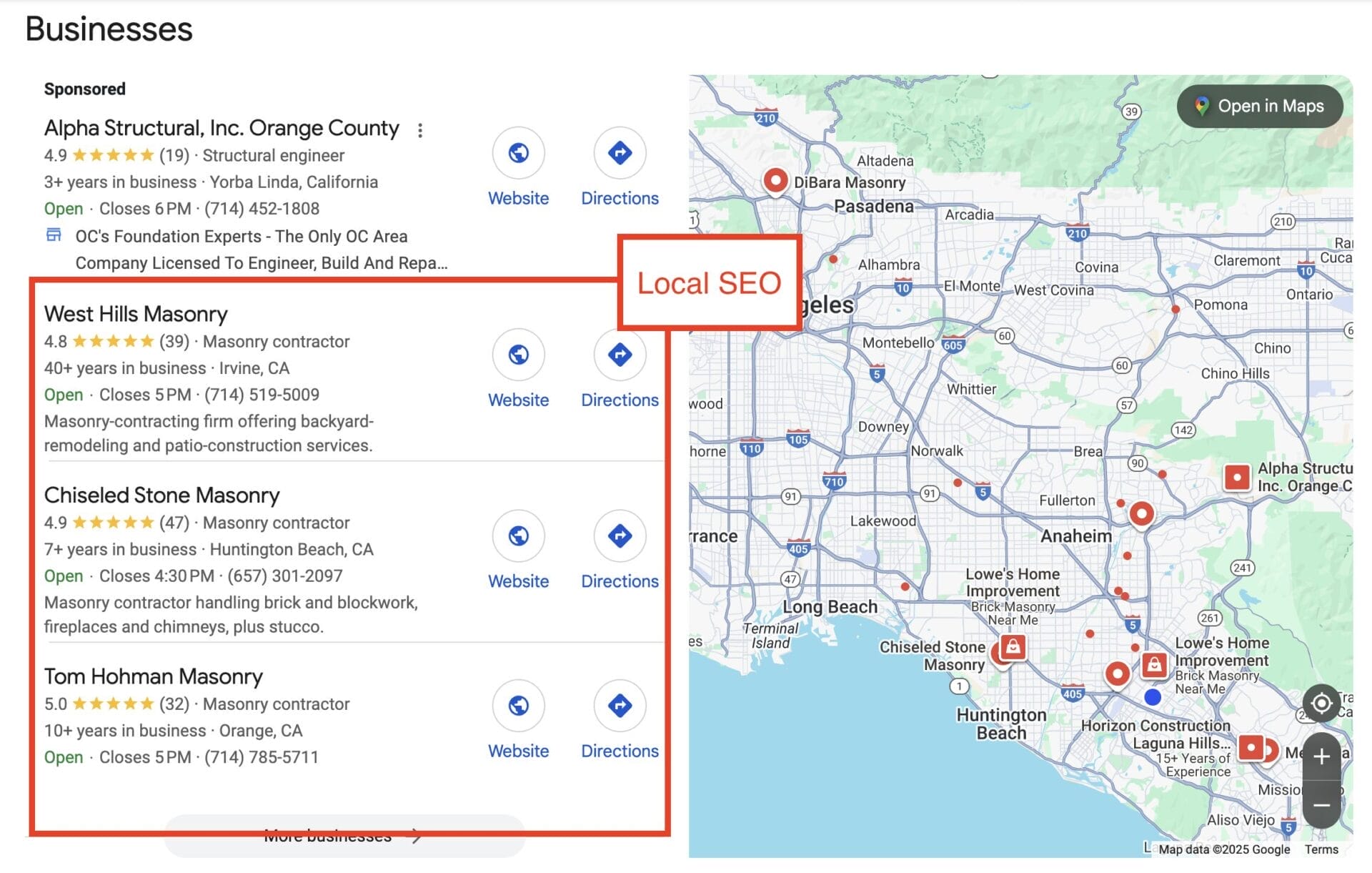
Local SEO involves optimizing your site with local keywords, adding your business to local directories, and making sure your contact information is consistent across the web. This helps your business appear in the “local pack” the map listings at the top of Google search results. For a mason in Los Angeles, strong local SEO means being visible to homeowners right when they’re searching for your services.
Google Business Profile (previously called Google My Business)
Your Google Business Profile is like your online storefront on Google Maps. When someone searches for masonry services in Los Angeles, your profile can show your business name, phone number, hours, photos of your work, and even reviews from past clients. Keeping this profile updated is one of the easiest and most effective ways to get new customers.
Add high-quality photos of your brickwork, patios, or stone walls, and encourage satisfied customers to leave positive reviews. The more active and accurate your profile is, the more likely Google will feature it when people search for masonry services nearby.
Why SEO is Important for Masonry Contractors in Los Angeles
Los Angeles is a competitive city for home improvement and construction services. Without SEO, your masonry business might get lost among dozens of other contractors. People rarely scroll past the first page of Google results, which means if you’re not ranking, you’re missing out on potential jobs.
With SEO, you can reach homeowners searching for masonry repairs, commercial clients needing stonework, or designers looking for reliable contractors. SEO builds trust and credibility, showing customers that your business is established and professional. In a city like Los Angeles where reputation matters, ranking high on Google can make a huge difference in the number of calls and projects you get.
Competitive Offer
Think about your competitors other masonry contractors in Los Angeles are probably also trying to get noticed online. Some may already be investing in SEO, while others are only relying on referrals or word of mouth. By taking SEO seriously, you gain an advantage.
A strong online presence shows potential customers that you are reliable, modern, and accessible. If a homeowner is deciding between two masonry companies, they’re more likely to trust the one with a polished website, lots of reviews, and clear information. SEO isn’t just about search rankings it’s about positioning your masonry business as the best option in a competitive market.
On-Page SEO
URL Slugs
A URL slug is the part of a web address that comes after your domain name. Instead of something long and confusing like “https://www.touchstonemasonryoc.com/page?id=123,” it should be simple and descriptive like “https://www.touchstonemasonryoc.com/brick-repair-los-angeles.” Short, keyword-rich slugs help both Google and people understand what the page is about.

Title Tags
Your title tag is the clickable headline that appears in Google search results. For a Los Angeles masonry contractor, a good example might be: “Touchstone Masonry.” Title tags should include your main service and your city so that local customers know right away that you serve their area.

Meta Descriptions
Meta descriptions are the short summaries under the title tag in search results. A strong meta description gives people a reason to click. For example: “Proudly serving southern Orange County for nearly 50 years. We are committed to ensuring a smooth process for our clients, regardless of the complexity.” This helps you stand out and encourages potential customers to visit your site.

Alt Tags
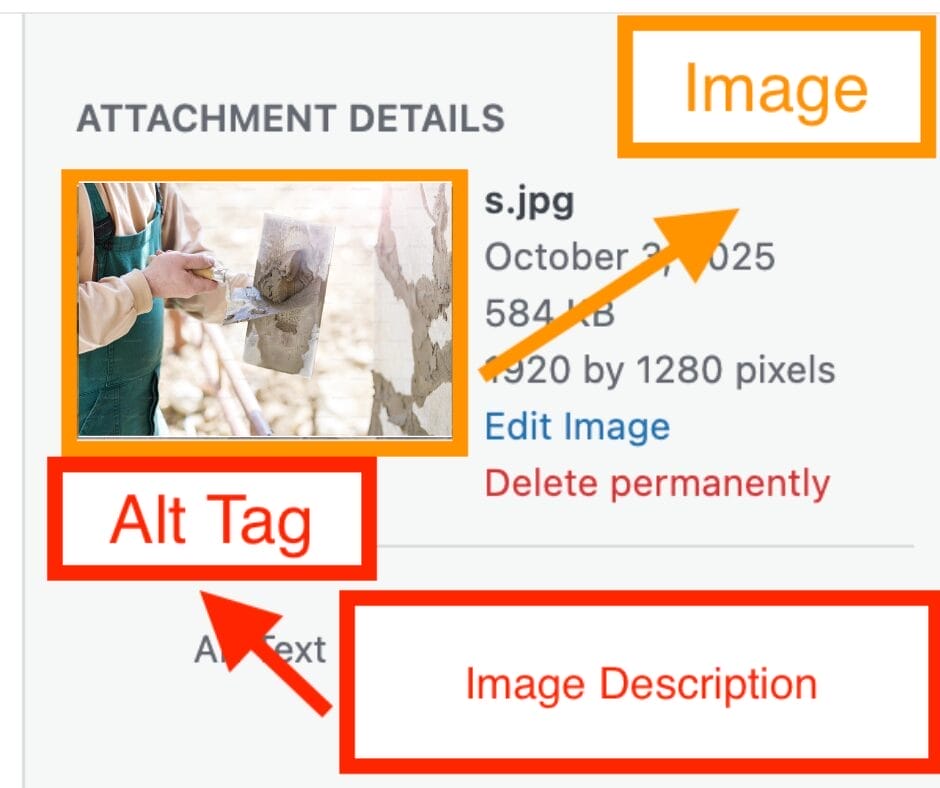
Alt tags are short descriptions you add to your images. Not only do they help people with screen readers, but they also tell Google what your photos show. For masonry, you can use tags like “brick wall installation in Los Angeles” or “stone patio by masonry contractor in Los Angeles.” This helps your images appear in Google Image search and brings in more potential customers.
Internal Links
Internal links connect one page of your website to another. For example, on your “brick repair” page, you could link to your “patio installation” page. This helps visitors discover more of your services and keeps them on your site longer. It also helps Google understand the structure of your website.
External Links
External links point to other websites. For example, you could link to a supplier’s site when talking about the materials you use. This shows Google that your content is trustworthy and backed by credible sources.
Compress Large Image Files
Masonry websites often have big, high-quality photos of past projects. While these photos are important, large file sizes can slow down your site. Compressing images makes your website load faster without losing quality. A faster site keeps visitors happy and improves your search rankings.
Improve Readability Level
Your website text should be clear and easy to understand. Avoid overly technical language and write in a way that an 8th grader could follow. Break content into smaller paragraphs, use headings, and explain terms when necessary. The easier it is for people to read, the longer they’ll stay on your site.
Optimize Website
Overall optimization means making sure your site works well for both users and search engines. This includes using the right keywords, having a clean design, and making sure the site loads quickly on all devices. An optimized site not only ranks better but also gives visitors a positive impression of your business.
Need Help Optimizing Your Business Website?
Understanding Keywords
Monthly Search Volume
When doing SEO, one of the first things you want to look at is monthly search volume. This simply means the number of times people type a certain word or phrase into Google each month. For example, if you are a masonry contractor in Los Angeles and you want to know how many people search for “brick repair Los Angeles,” the search volume will tell you whether it’s a popular term.
If only 20 people search for it each month, it might not bring in much business, but if 1,000 people search for it, then it’s definitely worth focusing on. High search volume usually means more potential customers, but it also often means more competition.
Keyword Difficulty
Keyword difficulty tells you how hard it will be to rank for a certain keyword. If a keyword has high difficulty, that means a lot of other businesses are already trying to rank for it. For example, “masonry contractor Los Angeles” might have high difficulty because many companies are targeting it, but something like “stone wall repair in Los Angeles” may be easier to rank for. By balancing search volume with keyword difficulty, you can choose keywords that are realistic to target and still bring you good traffic.
Use Relevant Keywords to Your Business
It’s not enough to just pick random keywords. The keywords you use must actually relate to your business and services. If you are a masonry company in Los Angeles, your keywords should focus on things like “brick repair Los Angeles,” “stone patio installation,” or “Los Angeles retaining wall builder.”
Using relevant keywords ensures that the people who visit your website are actually interested in your services. If you target something too broad like “home improvement,” you might get visitors who are looking for painters or electricians instead of masonry work.
Choosing the Right Target Keywords for Your Business
When choosing keywords, think carefully about what your ideal customers would type into Google. For example, a homeowner in Los Angeles who notices cracks in their brick wall might search “Los Angeles brick repair contractor.” A commercial property manager might search “stone masonry contractor in Los Angeles.” Choosing the right keywords means stepping into the shoes of your customers and figuring out exactly what they would search for when looking for your services.
Long-Tail Keywords
Long-tail keywords are longer, more specific phrases. Instead of just “masonry Los Angeles,” a long-tail keyword might be “affordable stone patio builder in Los Angeles.”
While fewer people may search for long-tail keywords, the ones who do are usually closer to hiring someone. Long-tail keywords are powerful because they target customers who already know what they want. For example, “Los Angeles brick wall repair near me” is much more specific than just “masonry,” and it usually leads to higher-quality leads.
Short-Tail Keywords
Short-tail keywords are the opposite of long-tail. These are short, general terms like “masonry” or “brick repair.” While these keywords usually have very high search volume, they also have very high competition and are not as targeted. Someone searching “masonry” could be looking for contractors, history information, or even DIY tips. For a Los Angeles contractor, short-tail keywords can be part of your strategy, but they work best when paired with long-tail ones that bring in more qualified leads.
Keyword Research Tools
To find the best keywords, you’ll need keyword research tools. These tools give you data on search volume, difficulty, and related terms.
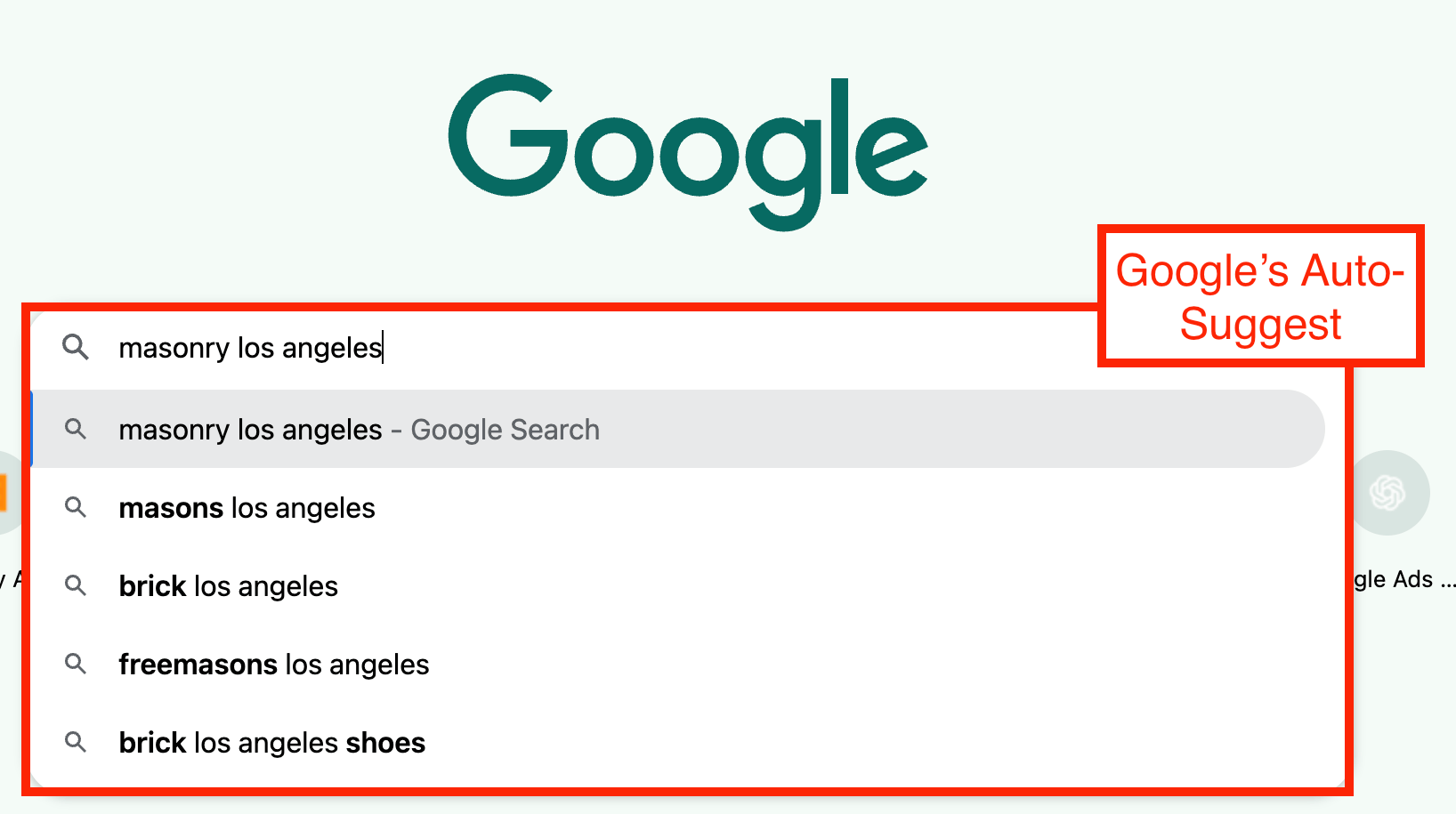
Google’s Auto-Suggest (Autocomplete Predictions):
When you start typing “masonry Los Angeles” into Google, it shows you a drop-down list of other related searches people often use. These suggestions can help you discover new keywords to target.
Google’s Related Searches:
At the bottom of the search results page, Google lists “related searches.” For example, if you search “brick repair Los Angeles,” you might see related searches like “stone wall repair Los Angeles” or “patio masonry Los Angeles.”

Google Keyword Planner:
A free tool that shows search volumes and keyword ideas. It’s especially helpful for businesses starting out.
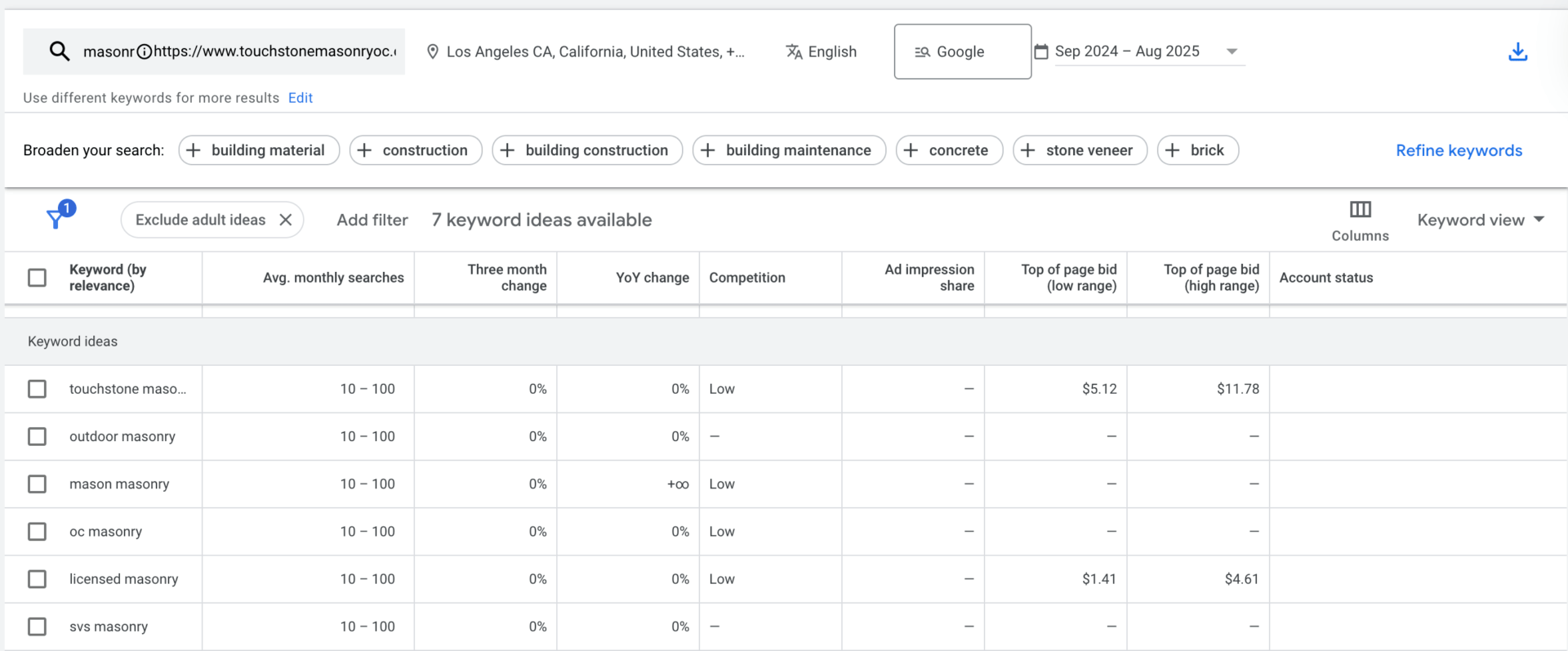
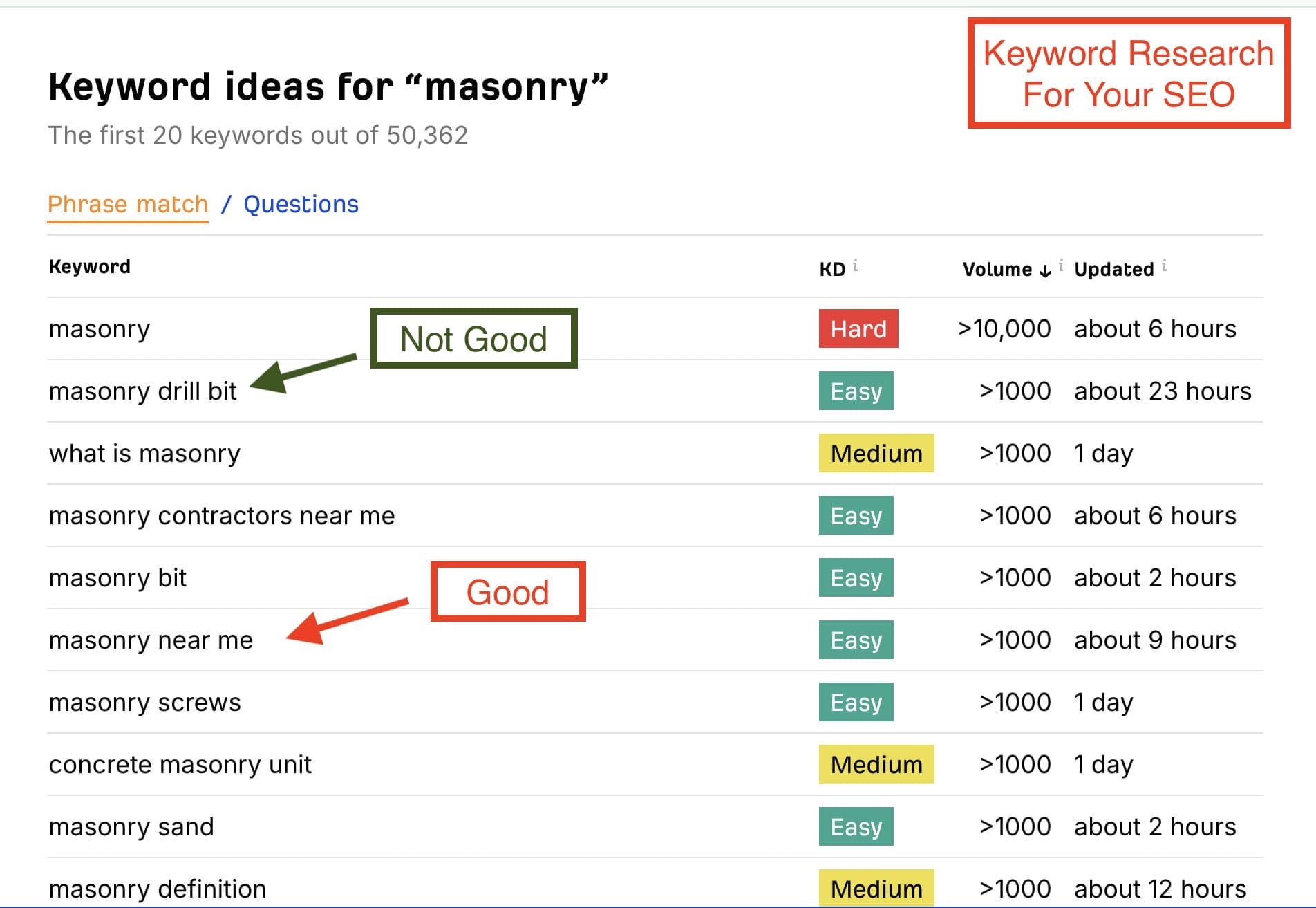
Ahrefs Free Keyword Generator:
A tool that lets you type in a word like “masonry Los Angeles” and gives you a list of keyword ideas with search volume and difficulty scores.
Why “Masonry Contractors Near Me” Is a Good Keyword
Local, High-Intent Search
When someone types “masonry contractors near me”, they’re actively looking for a professional to build or repair brick, stone, or concrete structures. This shows strong buyer intent they’re not just browsing, they want to hire.
Service-Based Need
Unlike broad terms like “what is masonry,” which attract students or researchers, “masonry contractors near me” comes from homeowners, businesses, or developers who actually need work done. That makes it an excellent keyword for generating leads and sales.
Helps You Rank in Local Pack
Optimizing for this keyword increases your chances of appearing in Google’s Local Pack (map results), where most people click first when searching for local contractors. This puts your business right in front of the most motivated prospects.
Direct Revenue Opportunity
This keyword is tied directly to projects like stone walls, patios, chimneys, or foundations all high-ticket services. That means ranking for it can lead to large, profitable jobs for your business.
Why “Masonry Drill Bit” Is Not a Good Keyword
Product Search, Not Service Search
When someone searches “masonry drill bit,” they’re looking to buy a tool for drilling into brick, stone, or concrete. This is a retail keyword, not a service keyword. These users want to purchase equipment, not hire a masonry contractor.
Wrong Audience
Your ideal customers are homeowners, builders, or businesses who need masonry work done, like patios, chimneys, or stone walls. People searching for a drill bit are usually DIYers or contractors who plan to do the work themselves — not pay you.
Dominated by Retailers
Keywords like this are heavily dominated by Home Depot, Lowe’s, Amazon, and hardware suppliers. Competing against them is nearly impossible, and even if you did, it wouldn’t bring in qualified leads.
Low Conversion Potential
Even if your website got traffic from this keyword, those visitors wouldn’t call you for masonry work. They’d just leave after realizing you don’t sell tools, which increases your bounce rate and lowers your site’s authority in Google’s eyes.
Track Keyword Ranking with Serprobot
Once you’ve chosen your keywords, you need to keep track of how well your website is ranking for them. Tools like Serprobot let you type in your website and keywords, then show you what position your site is in on Google. For example, you might start out ranking on page 5 for “stone masonry Los Angeles,” but after a few months of SEO work, you could move up to page 1. Tracking your rankings shows whether your strategy is working and helps you know where to focus your efforts.
Understanding Search Intent
Informational Intent
Some people search for information rather than services. For example, a person in Los Angeles might search “how to repair a cracked brick wall.” They may not be ready to hire a contractor yet, but if your website provides a helpful blog post answering that question, you can build trust with them. Later, when they realize they can’t fix it themselves, they’ll remember your company.
Navigational Intent
Navigational intent happens when someone is looking for a specific company or website. For example, if someone in Los Angeles has already heard of “ABC Masonry,” they might type “ABC Masonry Los Angeles” into Google. To capture these searches, you need to make sure your business name is easy to find online, and that your website is ranking for branded searches.
Commercial Intent
Commercial intent is when people are researching before making a purchase. For example, “best masonry contractors in Los Angeles” or “top-rated brick repair near me.” These searchers are comparing options and looking at reviews. If your site has testimonials, photos of your past projects, and clear service descriptions, you’ll appeal to these searchers and increase your chances of being chosen.
Transactional Intent
Transactional intent is the strongest type of search intent it means the person is ready to hire someone right away. Searches like “hire masonry contractor Los Angeles” or “affordable brick wall repair near me” show the person is ready to take action. To capture these leads, your website should make it easy for them to call, request a quote, or book an appointment.
Struggling with keywords for your SEO?
Off-Page SEO
Backlinks
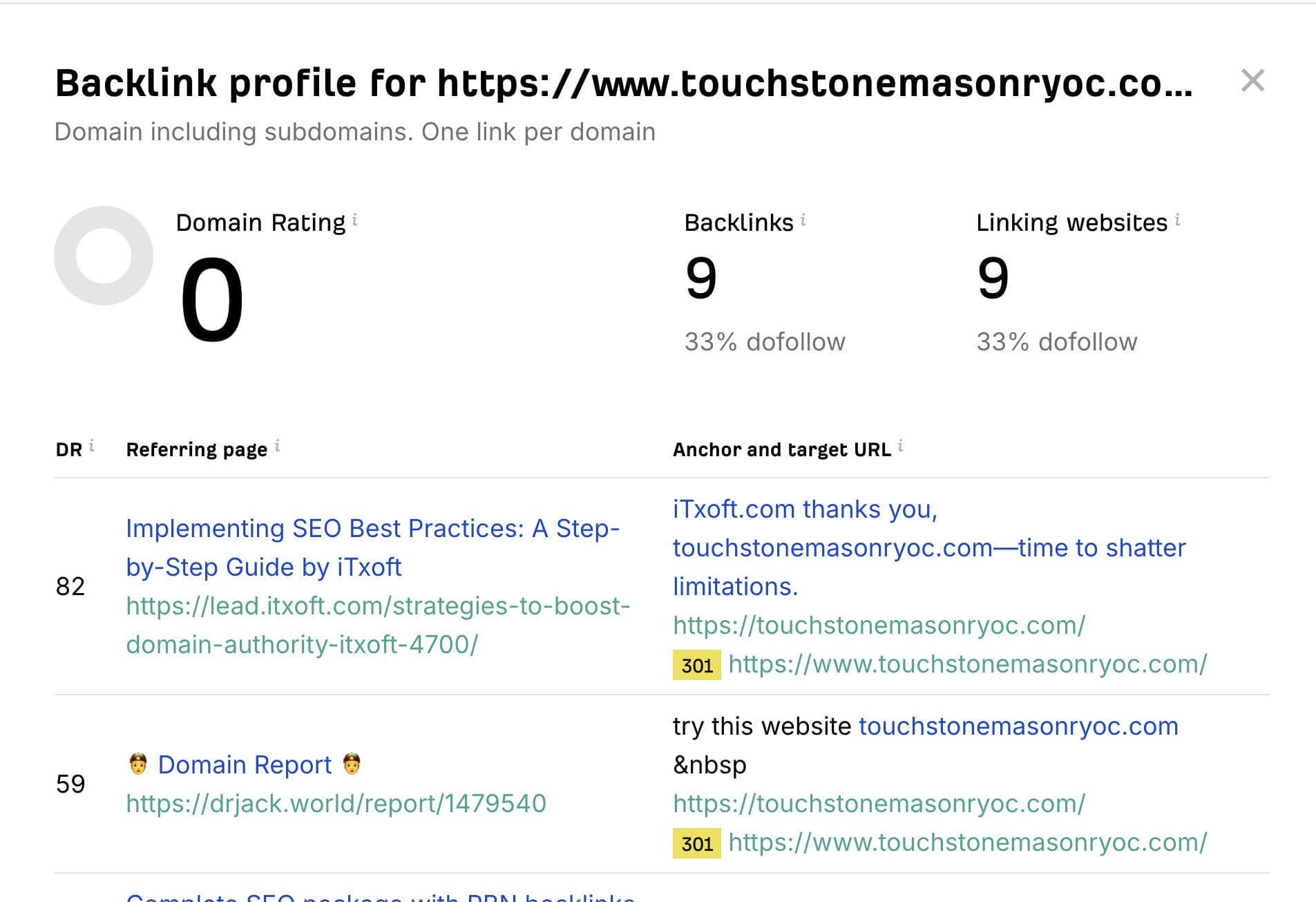
Backlinks are links from other websites that point back to your own website. Think of them like votes of confidence. If a trusted website links to your masonry business in Los Angeles, Google sees that as a sign your site is valuable and trustworthy. For example, if a local home improvement blog in Los Angeles writes an article about “Best Masonry Contractors” and links to your business, it tells Google that your company is worth recommending. The more high-quality backlinks you have, the higher your chances of ranking on the first page of search results.
Guest Posting
Guest posting means writing articles for other websites that already have a strong audience. For example, you could write a blog post for a Los Angeles landscaping company’s website about “How Masonry Improves Outdoor Spaces.”
In that article, you can link back to your own website. This not only gives you a backlink but also puts your business in front of new potential customers who might not have known about you otherwise. It’s a win-win because you provide helpful content to someone else’s audience while also improving your own visibility online.
Content Marketing
Content marketing is all about creating useful, valuable, and engaging content that attracts potential customers. For a Los Angeles masonry business, this could mean publishing blog posts about “Top 5 Masonry Trends for Outdoor Living in Los Angeles” or making videos showing before-and-after transformations of patios and brick walls.
Content marketing helps you build authority and trust, making people more likely to hire you when they need masonry work. When you share your expertise online, people start to see you as an expert, which also makes Google more likely to rank your site higher.
Social Media Marketing
Social media platforms like Facebook, Instagram, and TikTok are powerful tools for promoting your masonry services in Los Angeles. Posting photos of your completed stone patios, brick walkways, or custom fireplaces can catch people’s attention and inspire them to want the same for their home.
Social media also helps your content get shared more widely, which can lead to more website visits and even backlinks. If someone in Los Angeles sees your beautiful work on Instagram and shares it, that can introduce your company to dozens of new potential clients.
Local Listings
Local listings are online directories that feature local businesses, such as Yelp, Angie’s List, and Houzz. Having your masonry business listed in these directories makes it easier for people in Los Angeles to find you when searching for contractors. It’s also important to make sure your Google Business Profile (formerly Google My Business) is fully set up with your address, phone number, services, and photos. When someone searches “masonry contractor near me” in Los Angeles, Google often shows local listings at the top, which can give you a major advantage over competitors.
Online Forums
Online forums are discussion websites where people ask questions and share advice. Sites like Reddit, Quora, or even local community groups in Los Angeles can be places to engage with people asking about masonry.
For example, if someone asks, “How much does it cost to repair a brick wall in Los Angeles?” you can provide a thoughtful answer and mention that your company offers those services. This builds credibility, helps people trust you, and can even lead to direct business.
AI SEO (LLM SEO, GEO, GSEO, ChatGPT SEO)
Optimizing for ChatGPT, Gemini, and Perplexity
AI SEO is a new part of digital marketing where businesses try to make sure their content shows up in answers generated by AI tools like ChatGPT, Google’s Gemini, and Perplexity. These tools scan the internet and summarize information for users. For example, if someone in Los Angeles asks ChatGPT, “Who are the best masonry contractors in Los Angeles?” the AI might mention your business if your content is strong, unique, and well-optimized.
What AI SEO Is
AI SEO is the practice of making your content easier for artificial intelligence tools to find and use. Unlike regular Google search, which shows a list of websites, AI tools provide answers directly to people. If your website has unique information about masonry in Los Angeles, like pricing details, project examples, or expert advice, there’s a higher chance AI will include your business in its answers.
Similarities Across Platforms
ChatGPT, Gemini, and Perplexity all aim to give users quick and accurate answers, and they all rely on scanning the internet for the most relevant and trustworthy content. They value fresh information, clear explanations, and well-structured content. So if your masonry website in Los Angeles has detailed service pages, blogs with step-by-step guides, and clear project photos, it has a strong chance of being noticed by all three.
Differences Between Platforms
Even though these AI tools are similar, they each prioritize slightly different things. For example:
-
ChatGPT often pulls from blogs, articles, and structured how-to content, so detailed guides like “How to Repair a Brick Wall in Los Angeles” might help you show up.
-
Gemini (Google’s AI) puts more weight on local and factual information since it’s connected with Google’s search engine, so your Google Business Profile and local reviews are more important here.
-
Perplexity focuses heavily on trusted sources and citations, so it may highlight your business if your content is linked to by other respected sites or publications.
Why Unique Content Matters
If your website only has generic content that looks like every other masonry contractor’s site, AI may not include you in its results because it doesn’t provide anything new. For example, if every business says “We build patios and repair brick walls,” but your site has detailed guides like “Average Cost of Brick Repair in Los Angeles in 2026,” AI sees your content as more valuable because it adds fresh insights. The more unique, detailed, and helpful your information is, the higher your chances of showing up in AI answers.
YouTube and PR Articles Help
AI tools don’t just look at websites they also pull summaries from YouTube videos and online news articles. This means creating a YouTube video showing a “Step-by-Step Masonry Project in Los Angeles” or being featured in a local press release about your company can boost your chances of being mentioned in AI-generated answers.
AI Changes Constantly
One important thing to remember is that AI tools are always updating. The way ChatGPT prioritizes content today may change in six months, and the same goes for Gemini and Perplexity. That’s why it’s important to consistently add new content, share unique insights, and stay active across multiple platforms.
Technical SEO
Website Security (HTTPS)
Website security is one of the first things both Google and your customers look for. When your masonry website in Los Angeles uses HTTPS (which shows a little lock symbol next to your web address), it tells people that their information is safe when browsing your site or filling out a contact form.
A secure website builds trust because nobody wants to share their phone number, email, or even credit card information on a site that doesn’t look safe. On top of that, Google favors websites with HTTPS, meaning your site could rank higher simply by being more secure. For masonry contractors, this small technical update can make a big difference in attracting and keeping leads.
Page Speed
How fast your website loads is another critical factor in SEO. People today don’t like waiting, and if your masonry website takes more than a few seconds to load, most visitors will leave and check out your competitors instead. In a busy city like Los Angeles, where people often search for services while on their phones, page speed becomes even more important.
Optimizing your images, reducing unnecessary code, and using a good hosting service can all help your pages load faster. A speedy site not only improves user experience but also tells Google that your site is well maintained, which helps boost your rankings.
Mobile-Friendly Website
Most homeowners in Los Angeles who are searching for masonry services are doing it on their phones. If your website is not mobile-friendly, meaning it doesn’t adjust well to different screen sizes, people will have a hard time navigating your pages, clicking buttons, or reading your content.
A mobile-friendly design makes your site easy to use whether someone is on a laptop, tablet, or smartphone. Google also gives priority to mobile-friendly websites in search results, so this step is crucial if you want more customers to find your business.
Keyword Cannibalization
Keyword cannibalization happens when you have too many pages on your website targeting the same keyword. For example, if your masonry company in Los Angeles has multiple pages all focused on “brick wall repair Los Angeles,” Google may get confused about which page to rank and end up not ranking any of them well.
The solution is to make sure each page on your site has a clear and unique focus. One page might focus on brick repair, another on patio installation, and another on stone veneer. This way, you avoid competing against yourself and give Google a clear idea of which page to show for each search.
Fix Duplicate Content
Duplicate content means having the same or very similar text on multiple pages of your website. This can hurt your SEO because Google doesn’t like showing the same content in search results multiple times. For example, if you copy the same description of your masonry services onto several pages, it might lower your chances of ranking.
Instead, make each page unique by adding location-specific details, project examples, or frequently asked questions. For a Los Angeles masonry contractor, you could customize service pages with phrases like “brick wall restoration in Beverly Hills” or “patio paving in Santa Monica,” making each page unique and valuable.
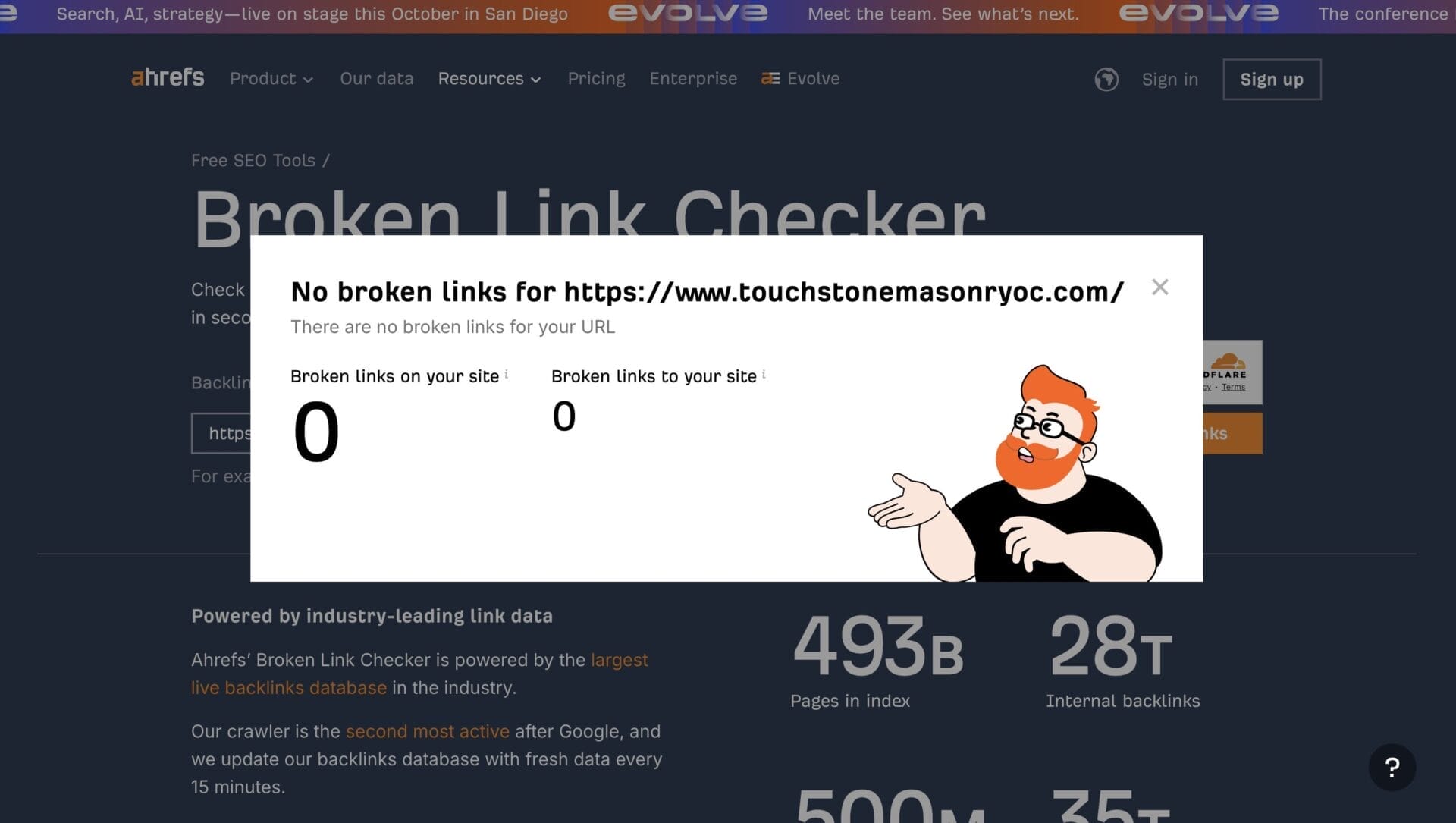
Fix Broken Links
Broken links are links on your website that don’t work anymore and lead to an error page. These can be frustrating for visitors and make your site look unprofessional.
Imagine a homeowner in Los Angeles clicking on a link to see your “stone patio gallery” and getting an error chances are, they’ll leave your site right away. Google also sees broken links as a sign that your website isn’t being maintained. Regularly checking your site and fixing broken links helps keep visitors happy and improves your SEO.
Improve User Experience (UX)
User experience, or UX, is all about how easy and enjoyable it is for someone to use your website. If your pages are cluttered, your text is hard to read, or your buttons are difficult to find, visitors are more likely to leave quickly.
A clean design with clear navigation, large readable fonts, and plenty of high-quality images of your masonry projects will keep people engaged. For Los Angeles homeowners, who may be comparing multiple contractors, a well-designed site could be the deciding factor in choosing your company over another.
Analytics and Monitoring
Analytics tools like Google Analytics or Google Search Console allow you to track how your website is performing. You can see how many people visit your site, which pages are most popular, and what keywords bring visitors in. For a masonry business in Los Angeles, this information is valuable because it shows you what’s working and what needs improvement. For example, if you notice that your “stone patio” page gets a lot of visits but very few calls, you may need to adjust the content or add a stronger call-to-action. Monitoring your site regularly helps you stay on top of your SEO game and continue improving over time.
Common SEO Mistakes to Avoid
Keyword Stuffing and Over-Optimization
One of the biggest mistakes businesses make is stuffing too many keywords into their content. For example, repeating “masonry contractor Los Angeles” over and over in every sentence makes your site look spammy and hard to read. Google’s algorithms are smart enough to recognize this, and instead of helping, it will hurt your rankings. Instead, use keywords naturally within sentences and combine them with related phrases like “brick repair,” “stone veneer installation,” or “patio paving” to make your content flow better.
Neglecting Mobile Optimization
A common mistake is not paying attention to how your site looks on mobile devices. In Los Angeles, where so many people rely on their phones, a non-mobile-friendly site will quickly drive away potential customers. If a homeowner tries to view your gallery of past masonry projects and the photos don’t load properly on their phone, they’ll likely leave your site and go to a competitor’s. Always test your site on mobile devices to make sure it looks and works just as well as it does on a desktop.
Ignoring User Experience
Another mistake is focusing only on ranking and forgetting about the people who visit your site. Even if you manage to get traffic, it won’t matter if visitors can’t find the information they’re looking for. For instance, if someone in Los Angeles lands on your site looking for “retaining wall construction” but your page is poorly organized, they might leave without contacting you. Good SEO is not just about getting clicks; it’s about keeping people on your site and convincing them to choose your business.
Conclusion
In a highly competitive market like Los Angeles, masonry contractors need to go beyond word of mouth and traditional advertising to grow their business. SEO provides a powerful way to connect with homeowners who are actively searching for services like brick wall repair, stone patio installation, or custom outdoor fireplaces. By combining technical improvements, strong on-page SEO, keyword research, off-page strategies, and even AI SEO, your business can stand out from competitors and attract more local leads. The key is to stay consistent, provide unique and valuable content, and keep improving your website over time. With the right SEO strategy, your Los Angeles masonry company can achieve long-term success, gain more visibility, and turn online searches into paying customers.


